Thinking · Marketing
Marketing is where the operating model breaks
First published on LinkedIn. Read it there and join the discussion →
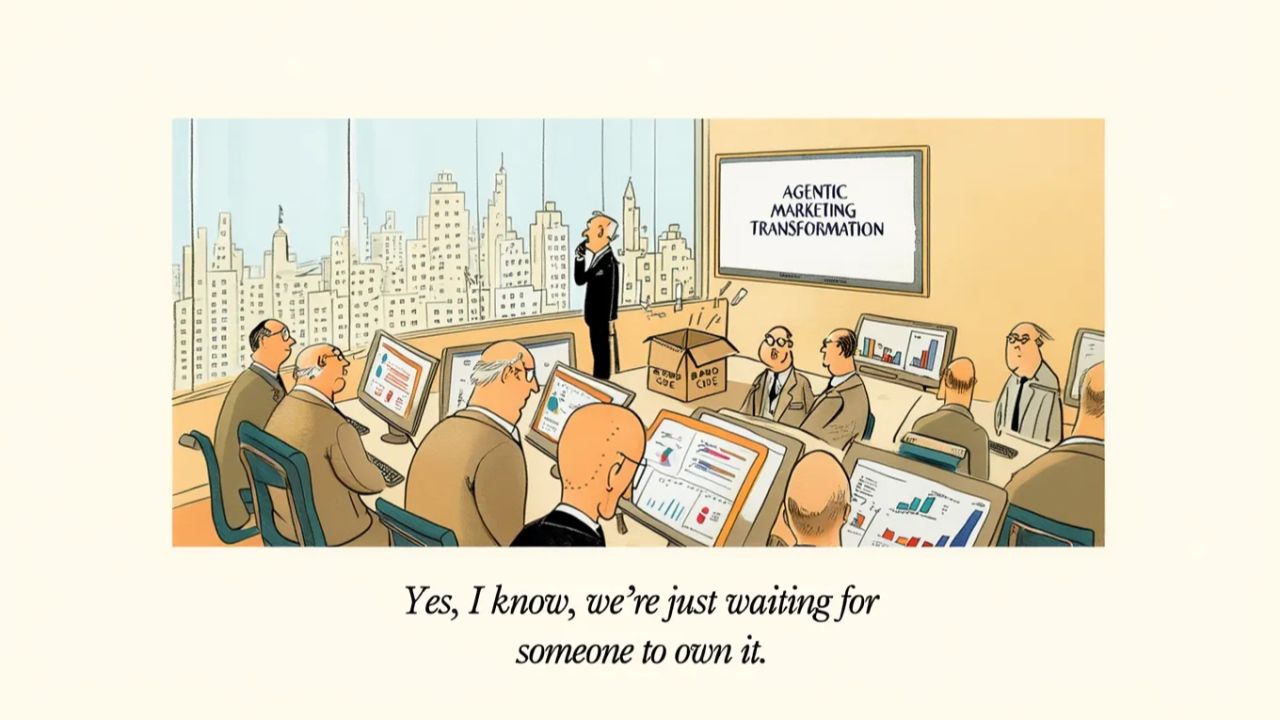
Harvard Business Review opens its agentic-marketing piece with a two-line dialogue. "We're ready to launch." "Marketing's not." It is smart framing and it does its work in the first paragraph: marketing is the function holding the rest of the business back. I have sat in those launch readouts. The line is not wrong, but it is not fully honest either. Marketing is not the bottleneck because marketers are slower than engineers. Marketing is where the bottleneck becomes legible. It sits downstream of product, ahead of sales, alongside support, accountable to finance. When the operating model is broken, marketing is the function where the break shows up first. The rest of the HBR article, to its credit, says exactly that.
What HBR gets right
The piece, written by Michelle Taite, John Winsor and Will Fernandez is the clearest mainstream statement to date that AI's marketing payoff is an operating-model question, not a tooling one. It is sequential, siloed and very coordination-heavy. That is the disease, and inserting agents into the existing workflow does not cure it. I fully agree.
The four-layer architecture is sound. Brand code as a machine-readable foundation. Specialized agents at the execution layer. Orchestration agents coordinating them above. A single conversational interface where intent goes in and outputs come back. The five workstreams the authors list (intelligence and ideation, content creation, research and testing, distribution, performance and reporting) are an almost complete inventory of what marketing actually does. The "marketer as director of work" shift is real, and most of the people I have hired in the last eighteen months were already hired against that brief, whether they knew it or not.
The article also names something the technical conversation about AI tends to avoid: the artifact at the centre matters more than the agents around it. Without a machine-readable knowledge base of the brand, none of the rest works. The agents become very fast generators of off-brand output. HBR's framing of the brand code as "always-on onboarding documentation that both people and agents need to be successful at their job" is benign, generous, and a little too small. The brand code is more than that. The next section is where that argument starts.
What Marzano already saw
Thomas Marzano was here six months ago. His November 2025 essay, "Brand Constitutions: The Legible-Lovable Standard for Building Equity in an Agentic Economy," proposed the artifact HBR now calls a brand code, and he had a sharper name for the human half of it. The Legible-Lovable Law: a brand must be machine-readable to be surfaced, and emotionally resonant to be chosen. HBR holds the first half. Marzano's framing holds both.
The convergence is not coincidence and not a slight. It is the timeline. The brand-side strategy community moved on machine-readable brand identity before the management literature caught up, and the two should be read on the same desk now. Marzano's follow-up, "Intent is the Interface" (March 2026), goes further: agency is a dial, not a switch, and the user moves between autopilot, exploration, and deliberation as the task demands. HBR's interface layer assumes a single setting on that dial. The conversation is more interesting if you read the management piece and the brand-side manifesto together.
The orchestration layer is where the politics live
HBR's own sentence: "What was once handled through project plans, status meetings, and manual handoffs is instead managed dynamically by the system." Read that line again, then list the roles that lived inside those project plans, status meetings, and manual handoffs. Integrated marketing managers. Project managers. Traffic managers. Marketing operations leads. The chief of staff to the CMO. The "system" absorbing them is a redistribution event the article treats as an efficiency gain.
But, it is not just efficiency. It is who owns the work that remains, who carries the risk when the system makes a call, and whose budget the layer sits inside. Three patterns keep showing up in the rooms I am sitting in.
The silo X-ray. You cannot deploy a customer-facing AI agent without resolving the fact that sales, marketing, support, and product own three competing versions of "the customer." The agent will not paper over that disagreement; it will pick one definition and ship. Gartner puts 41% of organizations citing siloed strategies as the primary barrier to AI deployment. AI did not create the silos. It made them legible.
The accountability vacuum. When the model drafts the brief, who signed off. When the agent sends the email, whose KPI absorbs the open rate. When the algorithm scores the lead, who explains the score to the dropped customer? Most organizations have not answered this. Most are pretending they have, until the first uncomfortable outcome.
The data ownership war. Data was a hoarding game when nobody could do much with it. Agents change the math. The team that owns the warehouse, the CRM, or the product telemetry now has leverage they did not have a year ago. Watch where the internal lobbying intensifies. That is the real organizational chart of power, not the one in the deck.
I argue that the brand code is not onboarding documentation. It is a political document. Whoever drafts it wins the next decade of budget allocation, accountability, and headcount. That is not pessimism, it is reading the org chart with the lights on.
The board's one investment thesis
What I found very interesting is that the HBR redesign assumes a CEO and a board ready to underwrite the agentic operating model as a growth investment, not just a cost savings aparatus. Most boards do not have that frame. McKinsey & Company's State of AI 2025 finds efficiency framing dominant across the field, with growth and innovation as the differentiators of high performers. Translated to plain language: most boards have exactly one investment thesis for AI, and it is labor replacement. It is the only AI ROI frame they were trained on.
The metrics HBR offers (materials adapted 98 times faster, unit costs down 80%, click-through rates up 17x) only read as growth investment if the board is ready to underwrite them on growth terms. Otherwise they collapse straight back into the cost-out thesis the article is trying to escape. The redesign keeps stalling at the strategy review because the strategic case for AI as redistribution has nowhere to land. The language to evaluate it does not exist around that table yet. Building that language is the part of the job the agentic marketing literature has not yet engaged with, and it is the part most of the CMOs I speak with have on their actual calendar.
The workstream that is missing
Five workstreams in the HBR piece: intelligence, content, research, distribution, performance. None of them is trust, governance, or brand safety.
In an agent-mediated environment with synthetic-audience testing, automated channel deployment, and dynamic routing, trust and safety cannot be an afterthought stapled onto the performance layer. They are a workstream of their own, with their own headcount, their own escalation paths, and their own seat in the orchestration layer. The HBR framework is largely built from inside the agentic infrastructure industry, with case studies at platform vendors; the trust workstream is the most consequential omission in the inventory. A redesign without a designed governance workstream is the redesign that produces the first regulatory crisis of the agentic era. The cost of that crisis lands on the CMO, not on the consultancy that drafted the framework.
Two sides of one architecture
The agentic marketing organization is the supply-side answer to a demand-side change Marzano named first. The same machine-readable architecture that lets HBR's brand code function inside the organization is what makes the brand surfaceable to the customer's own agent at the moment of decision. The internal redesign and the external shortlist are governed by the same design choices. They share a language and they will share a fate.
I wrote a longer argument earlier this year about the shortlist's structural lock-in (link in the reading list): how an agent that finds a brand that works for the user stops looking for alternatives, and what that does to discovery once the ad-supported funnel breaks. I will not re-run it here. The narrower point of this piece is that the brand code is not only the asset the orchestration layer needs. It is also the asset the customer's agent will read when it decides whether to place you on the shortlist. Same document, two audiences, two failure modes. The agentic redesign without that second read is the half of the redesign that goes to market with no idea what it is talking to.
Closing
HBR has drawn the architecture. The work that follows is not building it. It is deciding who gets to draft what sits in the middle, and which roles disappear into the orchestration layer when they do. That is a CMO conversation, a CFO conversation, a board conversation, and a legal conversation, in that order. The organizations that move fastest in the next eighteen months will be the ones holding those four conversations in the same room. Most are still scheduling them separately.
Reading list
Michelle Taite, John Winsor, Will Fernandez. "Redesigning Your Marketing Organization for the Agentic Age." Harvard Business Review, 8 May 2026.Thomas Marzano. "Brand Constitutions: The Legible-Lovable Standard for Building Equity in an Agentic Economy." Brandingmag, November 2025. (ask me for the PDF version if you are unable to register)Thomas Marzano . "Intent is the Interface." marzano-consulting.com, March 2026.McKinsey & Company. "The State of AI 2025: Agents, Innovation, and Transformation."Gartner, enterprise surveys on AI-ready data and information silos, 2025.MIT NANDA. "The GenAI Divide: State of AI in Business 2025." (Background, not cited in the piece, but an interesting read for whomever is interested in this space)Niels Langereis. "The shortlist effect has a dark side nobody's discussing." LinkedIn, April 2026.