Thinking · AI & Leadership
The CEO AI panic of 2026 is a governance failure, not a leadership one
First published on LinkedIn. Read it there and join the discussion →
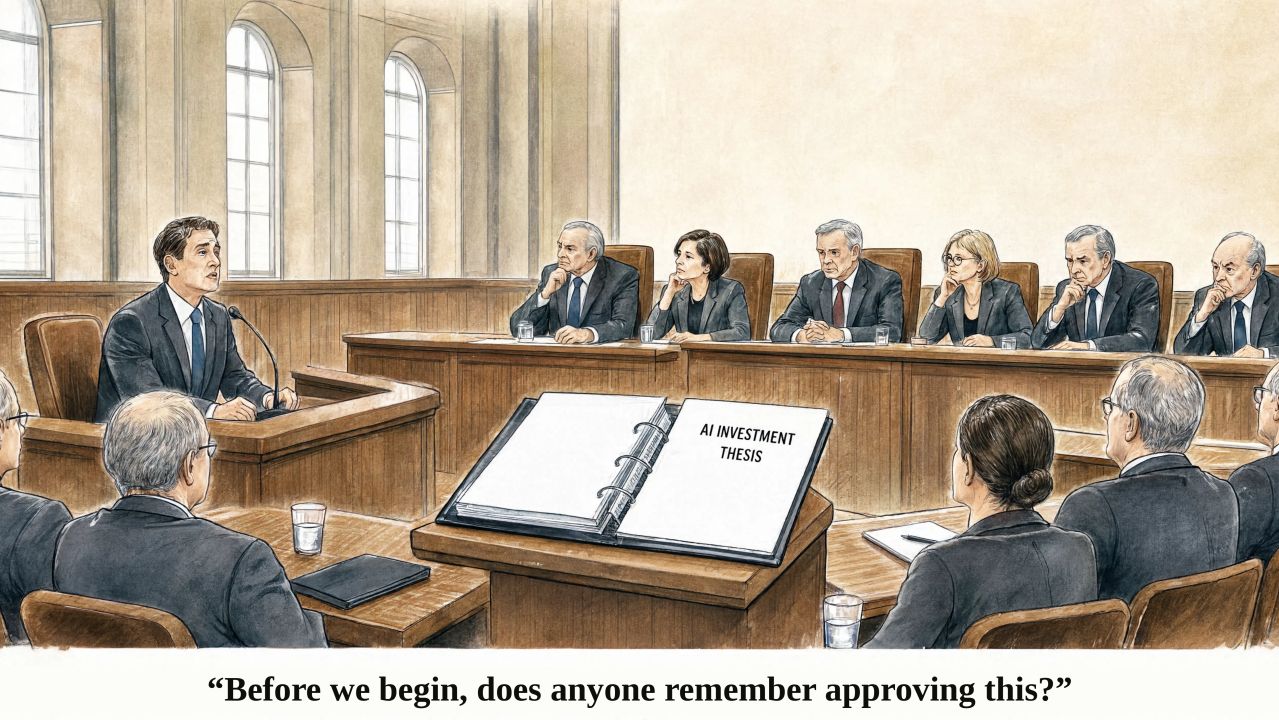
Why most CEOs blaming their AI vendor in 2026 are blaming the wrong room.
80% (!) of CEOs worldwide now expect to lose their job by year-end if their AI strategy fails. Dataiku's 2026 Global AI Confessions Report, a The Harris Poll of 900 chief executives, put that number on the record in May, the number is actually 81% inside the United States, and the business press read it as a productivity story. It is not, it is actually the moment the political economy of AI redistribution reached the corner office. I have spent over six months writing about that redistribution from the CMO seat, watching it climb the org chart one floor at a time. What we see now is that the numbers have caught up to the argument. The 80% is not a real verdict on AI, it is a verdict on how boards are treating it.
The disappointment gap is structural and widening.
48% of executives now call enterprise AI adoption a massive disappointment, up from 34% a year ago, in Writer's 2026 enterprise AI survey. PwC's 29th Global CEO Survey reads the same wound from another angle: only 12% of CEOs say AI has delivered both lower costs and higher revenue over the past year, and 56% say it has delivered neither. The gap is widening, not closing.
A cyclical gap closes on its own and this one is moving the wrong way because the support structure is wrong. Boards approved their AI budgets on a labor-replacement frame, because that is the frame their fiduciary-muscle (yes, this is a thing 😊) was trained on. The returns AI is actually delivering, judgment quality, decision speed, cross-functional reconciliation, customer mediation at scale, land in places that particular frame cannot (yet) price. A board can watch a headcount line fall. It cannot yet see a decision that got better, or a churn curve that bent because the first reply to a customer arrived three minutes faster.
So the board is not disappointed in AI. It is disappointed in its own investment thesis, and it does not yet know that is what it is looking at.
One investment thesis, and it is labor replacement
Why boards default to a cost-out thesis I have argued elsewhere; the short version is that cost reduction is the only ROI frame most of them know how to underwrite, and McKinsey & Company s State of AI 2025 already showed efficiency dominating as the stated objective while the high performers quietly also chased growth. The CEOs who lose their jobs in 2026 will mostly not be the ones who picked the wrong vendor. They will be the ones who tried to deliver growth-side AI returns to a cost-out board. MIT NANDA's finding that 95% of the $30 to $40 billion in enterprise generative AI spend shows no measurable P&L impact is simply symptom of this approach, in is not a structural "disease". The spend is real and the thesis cannot read the return.
The CEO is being judged on the wrong bet
This is where the 80% becomes a governance story rather than a leadership one. The board picked the investment thesis. I believe that the CEO is wrongly measured against it. The board underwrote one kind of bet, now grades the result of a different one, and files the shortfall under leadership. That is a category error, and dressing it up as a leadership problem only delays fixing the real one.
I have sat in the meeting where this conversation should have happened and did not. The board approves a budget on a slide that promises efficiency. Twelve or eighteen months later the same board asks why the company is not winning on AI-native product surfaces. Nobody remembers that the slide never funded that bet. The CEO carries the gap.
Eighty percent of CEOs are not at risk because they are bad at AI. They are at risk because most boards have not reconciled what they bought with what they now expect to see, and the CEO was the person closest to the room where that reconciliation never happened. You could and should argue that there is a clear role for the CEO to explain this, but right now she or he is part of the problem.
The work no one can outsource
There is one piece of this a CEO cannot delegate, and most have not done it. It is the unglamorous work of knowing, at the level of their own P&L and their own operations, where AI actually moves the cost curve, the cycle time, or the customer interface in their specific business. Not where the decks say it should, but where it actually does. Most have just read three consultancy decks on the question and proposed solution and have walked their own floor exactly zero times. That work looks like sitting with the head of supply chain, head of product, marketing or IT and asking which forecasting calls she would hand an agent, which she would not, and why.
To me the dependency is the tell. A leader who cannot run that hypothesis inside their own business has to import it, and the people they import it from, the consultancies, the platform sales engineers, are themselves still working out what AI means in any given P&L. They are not gatekeepers of settled knowledge. They are either solving it alongside you or reselling a single playbook. Either way, the investment thesis you are betting your job on was written by someone who does not carry the consequence.
The org chart is the bottleneck, at executive scale
Fifty-four percent of C-suite executives told Writer.com's 2026 survey that AI adoption is tearing their company apart. The accountability vacuum I have described at the CMO altitude now sits inside the leadership team, where the stakes are significanlty higher. When "the model" drafts the strategy memo, no one has agreed who signs it. When it overstates a forecast on the earnings call, no one has agreed who explains it to the analysts. AI did not start that fight, it made it impossible to defer.
Inside a leadership team the argument is rarely about the model. The function that owns the warehouse wants the agent tuned for cost. The function that owns the customer wants it tuned for experience. The function that owns the P&L wants both and will fund neither really. Each of them was managing that tension by not naming it. The agent ships one answer into production and turns a standing disagreement into a quarterly number someone now has to sign off on.
The fix is a board that can underwrite redistribution
The CEOs who survive the next eighteen months will be the ones who moved their boards onto a workable investment thesis before the cost-out frame collapsed under its own weight. That work is slow and almost invisible. It is one conversation with the audit chair about which line an AI return belongs on, another with the nominating committee about which competence the board is missing, another with the chair about how the company will measure judgment-augmenting returns when audit has no template for them.
It is also the only work that matters here. A better CEO will not rescue a board that can price only one kind of bet. A capable board will give a competent CEO room to deliver the returns a cost-out frame cannot see.
The same consultancies that sold boards the labor-replacement frame in 2024 are selling them the scale-or-fail frame in 2026. The meter runs in both directions.
The arc
If the foundation here is unfamiliar, parts one and two of this series lay it down: "The shortlist effect has a dark side nobody's discussing" on the customer side of agent-mediated discovery, and the HBR response on the CMO operating model. This piece is the same redistribution event, seen from the board.
Closing
My belief is that AI has a long way to go to proof itself an indispensable moneymaker, but it is going to be fine. The investment thesis is the real problem. It seems to me that CEOs being held accountable for AI in 2026, are being held accountable for a bet their boards never knew they were placing. Reconciling that bet with the returns AI is actually delivering is the work waiting in the next board meeting, and most of those rooms still do not know they are facing this issue
Reading list
Dataiku , Global AI Confessions Report 2026 (Harris Poll of 900 CEOs; 80% say their job is at risk by year-end if AI underperforms, 81% in the US). Press coverage: Fast Company, Fair Play Talks. Primary release via BusinessWire.WRITER Enterprise AI adoption in 2026 (with Workplace Intelligence; 48% call adoption a massive disappointment, up from 34%; 54% say it is tearing their company apart). Press release.PwC , 29th Global CEO Survey, 2026 (only 12% of CEOs report AI delivered both lower costs and higher revenue; 56% saw neither). Coverage: Fortune.McKinsey & Company , The state of AI in 2025: Agents, innovation, and transformation (efficiency is the near-universal stated objective; high performers also set growth and innovation).Massachusetts Institute of Technology Project NANDA, "The GenAI Divide: State of AI in Business 2025" (95% of $30 to $40 billion in enterprise generative AI spend shows no measurable P&L impact). Coverage: Fortune.HCLTech , Enterprise AI Market Report: The AI Impact Imperatives, 2026 (43% of major enterprise AI initiatives expected to fail). Held in reserve; not cited in body.