Thinking · AI & Talent
If AI takes the junior work, where does the next senior come from?
First published on LinkedIn. Read it there and join the discussion →
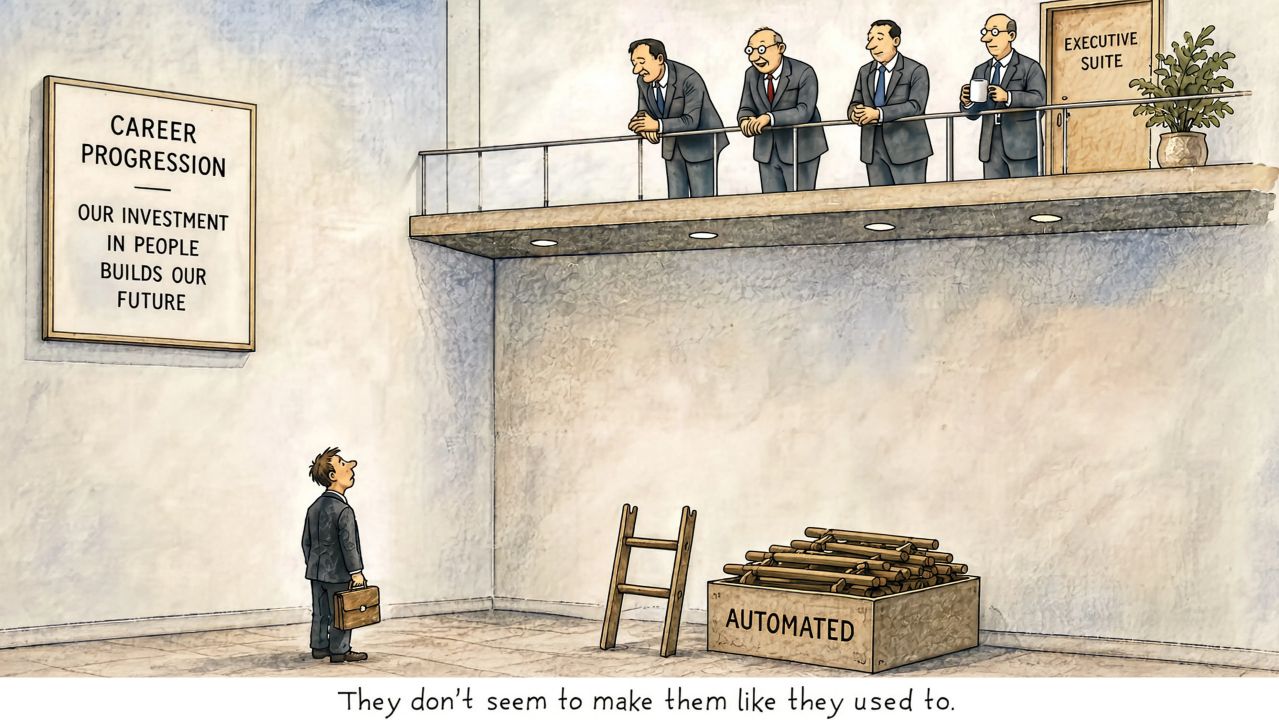
The most useful talk I have watched on building teams in an agentic world spends its entire length on how the system learns. Which is exactly why it makes worth arguing with.
Thomas Marzano pointed me to it, an Amazon Web Services (AWS) session by Steven Brovich a 27-year Amazon veteran who now sits with executives working through this shift. His framing is honest and well evidenced, and it lands on a problem the whole industry seems to be circling without quite naming it.
Start with his diagnosis, because the data behind this is stronger than the usual AI-and-jobs noise. Brovich leans on Anthropic's labour-market research, which actually did something most exposure studies do not. Instead of asking what an AI could theoretically do, it measured what it is actually doing, by combining the O*NET database of 800 occupations with real usage data. The gap is large: in computer and mathematical work, the kind you would expect AI to have eaten first, theoretical exposure sits above 90 percent while observed exposure is around a third. Conclusion 1: AI is not yet doing most of what it could.
Underneath that reassuring headline sits a sharper one, and it is not Anthropic's. A Stanford study led by Erik Brynjolfsson, titled "Canaries in the Coal Mine," found a 13 percent relative decline in employment for early-career workers in the most AI-exposed jobs since generative AI arrived, while employment for older, more experienced workers in the same roles held steady or grew. Conclusion 2: The execution layer is not vanishing evenly. It is vanishing from the bottom, where people used to start.
Brovich sees this clearly. His answer is the hourglass: execution at the top, a lean middle, and juniors deliberately kept in the pipeline, learning the craft on the way up. He quotes AWS chief executive Matt Garman, who called replacing junior staff with AI the dumbest idea he had heard, and asked the obvious question: how does it work when, ten years out, you have no one who has learned anything? The warning is right. Most organisations are cutting the base to hit the return their boards want, and overpaying for seniors at the same time.
So far so goog, but here is where the talk stops one move short.
Brovich's prescription is structural, not mechanical. Keep hiring juniors. Protect the base. House them in the hourglass. But he never says how the junior actually learns once the rungs are gone. The contradiction sits in plain sight: AI absorbs the execution layer, and juniors are still meant to learn the craft by doing execution. Both cannot hold. If the small calls that used to form people are now exactly the ones the system resolves on its own, then keeping juniors on the payroll does not, by itself, form them. You can preserve the base and still produce a generation that never earns judgement.
I believe that this is the gap nobody is pricing in. A system can inherit judgement. It cannot make more of it.
And it is not only Brovich arriving at this wall. Werner Vogels (Amazon's CTO) used his final re:Invent keynote to describe the "renaissance developer," the builder whose value is curiosity, systems thinking and polymathy rather than raw output. At the same time Martin Fowler and his colleagues at Thoughtworks have been making the same case for the "expert generalist," prized for first-principles judgement over tool fluency. Thomas Marzano arrives from the brand side entirely, arguing in his Brand Constitutions manifesto that as agents absorb execution, human value migrates upstream to constitutional judgement, and warning that firms will automate output faster than they regenerate the judgement to govern it.
Four very different approaches, one shared conclusion: the human who matters now is the one who judges. Almost none of them say how that judge gets made once the path that used to make them has been automated.
I believe the fix is not a workshop bolted onto the side of the system. It is a second loop built into it, on purpose.
The machine already runs an outcome loop, sense, decide, act, learn, and we "prompt" it obsessively because it drives throughput. Build a parallel loop aimed at people, on the same pipeline. Sample the small calls the system would otherwise auto-resolve, and route some to a junior. Surface the borderline cases instead of letting the machine smooth them away. Run shadow decisions, where a person rules first and only then sees what the system did. Make precedent review and escalation a ritual, not the thing you reach for after something has already broken. The same automated pipeline that dissolved the old apprenticeship is, if you recreate it for human formation rather than pure efficiency, the best training ground for judgement we have ever had.
Even the regulators are circling it. Singapore's Model AI Governance Framework for Agentic AI, launched at Davos in January and the first state-backed framework of its kind, puts human accountability at its centre, with every agent action traceable to a named human who answers for it. The 'natural' instinct and response is correct: keep a person accountable. Because what no framework supplies, is the mechanism that keeps producing people capable of carrying that accountability. You can mandate a human in the loop and still run out of humans worth putting there.
So two simple loops: One loop keeps the system learning. The other keeps us able to. Most agentic roadmaps fund the first and assume the second takes care of itself. I believe it will not and is not able to.
The organisation that wins the next decade is not the one with the most autonomous - self learning and self learning system. It is the one that still knows how to make a new judge. So the question worth putting on every agentic roadmap is not what can we automate. It is who are we still forming. Most roadmaps cannot answer it.
Sources:
Steven Brovich, AWS session (YouTube) Anthropic, "Labor market impacts of AI: A new measure and early evidence"https://www.anthropic.com/research/labor-market-impacts
Stanford / Brynjolfsson et al., "Canaries in the Coal Mine" 'Fortune summary' https://fortune.com/2025/08/26/stanford-ai-entry-level-jobs-gen-z-erik-brynjolfsson/
Matt Garman on replacing junior staff with AI (The Register) https://www.theregister.com/2025/08/21/aws_ceo_entry_level_jobs_opinion/
Werner Vogels, the renaissance developer (re:Invent 2025, SiliconANGLE) https://siliconangle.com/2025/12/05/amazon-cto-werner-vogels-foresees-rise-renaissance-developer-final-keynote-aws-reinvent/
Martin Fowler et al., "Expert Generalists" https://martinfowler.com/articles/expert-generalist.html
Singapore IMDA, Model AI Governance Framework for Agentic AI https://www.imda.gov.sg/resources/press-releases-factsheets-and-speeches/press-releases/2026/new-model-ai-governance-framework-for-agentic-ai
Thomas Marzano, "Brand Constitutions: The Legible-Lovable Standard" Brandingmag https://www.brandingmag.com/product/brand-constitutions--the-legible-lovable-standard-for-building-equity-in-an-agentic-economy/213/