Thinking · AI & Talent
Juniors don't build judgement by overseeing AI
First published on LinkedIn. Read it there and join the discussion →

Last week I argued that if AI takes the junior work, we quietly stop forming the next senior. The comment thread did something amazing. There was so much collaborative thoughts (over 70 comments and counting) that I actually was handed over the missing pieces: how to instrument the fix, how to fund it, and where to aim it.
The second loop, made practical
So here is the practical sequel, and it runs on a grid most leaders already have. A competency matrix: skills and behaviours down the side, seniority across the top, from execution to tactical to strategic judgement. The answer is to build a second loop, a deliberate path to judgement now that the accidental one is closing.
Naming it was the easy half. The comment thread did the harder half, and handed over the pieces that make a second loop something you can actually run: the instrumentation, the funding, the economics, and a precedent. This is the practical sequel, built around a single tool a leader can use this week.
The tool: a gap analysis over a grid you already have
In the spirit of collaboration, in this fast and slightly mad AI-driven world where the one-eyed giants get to be kings, I have made this matrix structure freely available to download. It leans heavily on the brilliant work of Roland Grootenboer, who built the original Matrix as Blendle's first HR hire, and on Blendle for open-sourcing it years ago.
What I added sits on top of their structure: the gap-analysis layer, the two-pile split, the bench-strength readout, and the formation column that aims the second loop at the cells that need it. Take it, adapt it to your own roles, and pass it on.
You can download the sheet here
Oh, and no need to comment "AI gap analysis" below or slide into my DMs for the link. Call it my small protest against the comment-for-a-link economy. It is just here, free, for everyone.
The move is to run a gap analysis over every cell, and sort the work into two piles.
The first pile is work AI can now do with senior oversight. For these cells, the executional reps that used to form a junior are disappearing. This is exactly where the second loop has to be inserted, because the work will no longer form anyone by accident. You deliberately route a sample of these calls back to juniors: they shadow the decision, rule first, then compare their reasoning to what the system produced.
The second pile is work that always needs a human touch. The borderline case with no clean answer, the load-bearing assumption nobody flagged, reconciling competing analyses into one defensible call. These cells are where junior hours should be concentrated and protected, and where senior time is most valuable.
Then invert it. Most leaders will run exactly this analysis to find efficiency, to see what they can hand to a model. The argument is to run the same grid a second time for the opposite purpose: to find where formation just quietly broke, and to redraw the training schedule cell by cell, not role by role.
What it looks like worked through
Take a generic analyst. Data gathering and cleaning sits in the first pile; AI runs it with light oversight, the bench is four people deep, and there is almost no formation value left in it. So reclaim that junior time and spend it elsewhere.
Now look at the judgement rows. Borderline-case assessment, challenging a load-bearing assumption, designing the evaluation framework itself, reconciling competing views into one call. These stay human. And when you add a simple bench column, how many people can actually do each at the strategic level, the picture turns uncomfortable fast. The executional cells are four deep. The judgement cells are often one deep, sometimes two. Your resilience now lives entirely in the cells AI cannot touch, and several of them are a single resignation away from a gap nobody planned for.
That is the second loop's target list, made visible. Point the formation effort at the one-deep judgement rows first.
Why the human pile is not nostalgia
It would be easy to read the "always human" pile as sentiment, the bit we keep for ourselves because we are attached to it. It is not. The boundary is structural, and a paper published in December by Walter Quattrociocchi , Valerio Capraro and Matjaž Perc draws it precisely.
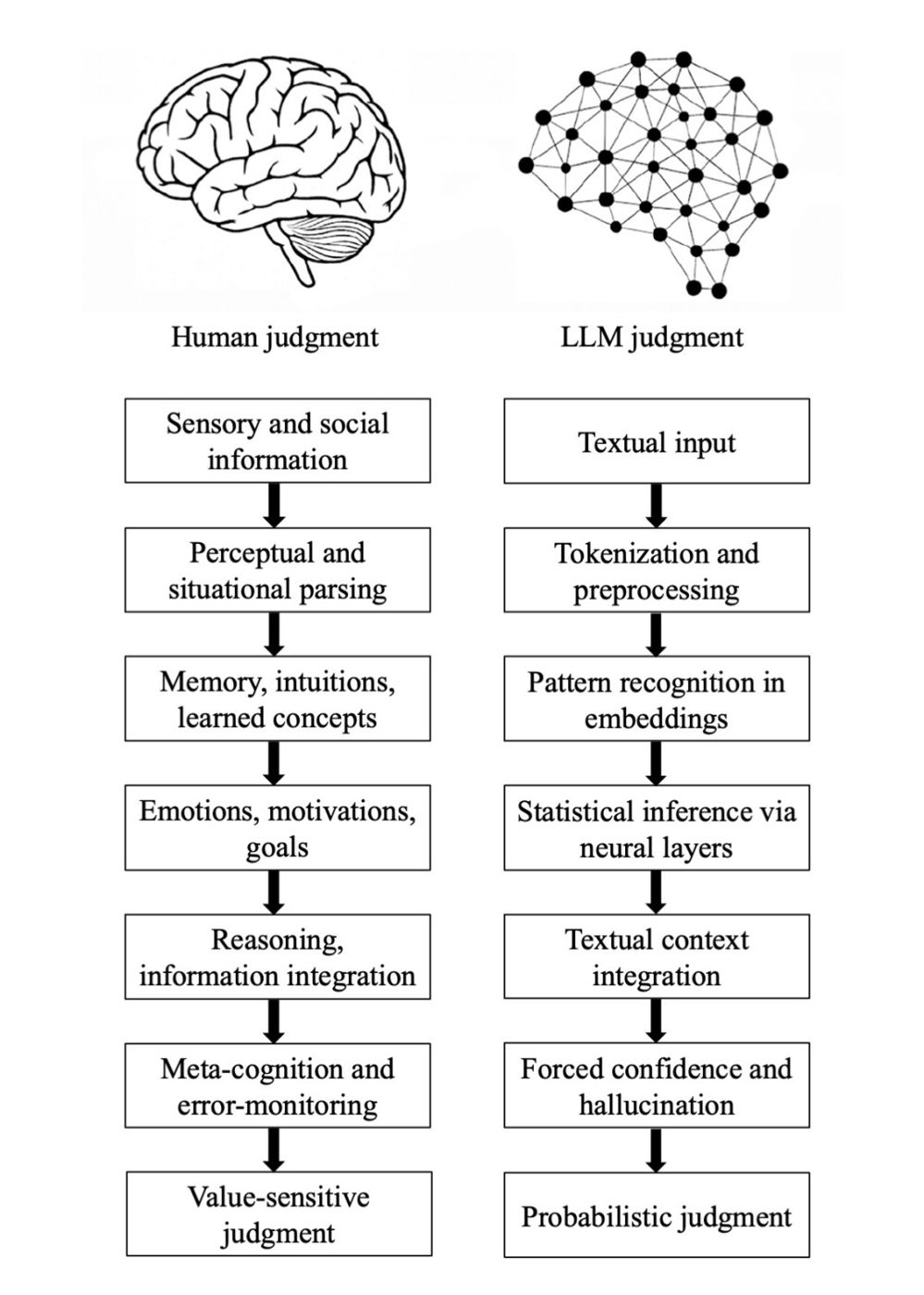
They map the human and machine judgement pipelines side by side. The human one runs from sensory and social input, through perception, memory, emotion and reasoning, and then through two stages the machine does not have: metacognition and error-monitoring, the checking of your own work, followed by value-sensitive judgement. The model's pipeline runs from textual input through tokenisation, pattern recognition and statistical inference, and then terminates in something quite different: forced confidence and hallucination, resolving to a probabilistic output. Same diagram shape, two stages missing on the right.
That gap has a name in their paper. They call the resulting condition Epistemia, a state in which linguistic plausibility substitutes for epistemic evaluation, producing the feeling of knowing without the labour of judgement.
Which is exactly the trap a junior falls into when they are handed fluent AI output and never made to interrogate it. They inherit the confidence without ever building the error-monitoring underneath it.
So the cells you protect are not the ones we are fond of. They are the ones that require the two steps the machine structurally skips. The second loop is not nostalgia for the old apprenticeship; it is the deliberate cultivation of the two faculties the model does not have. And it connects straight back to the build-side point Anish Mitra made in the thread: the apprentice has to adjudicate against the criteria before seeing the system's answer, because the moment they see the confident output first, the labour of judgement is the thing they skip.
The instrumentation
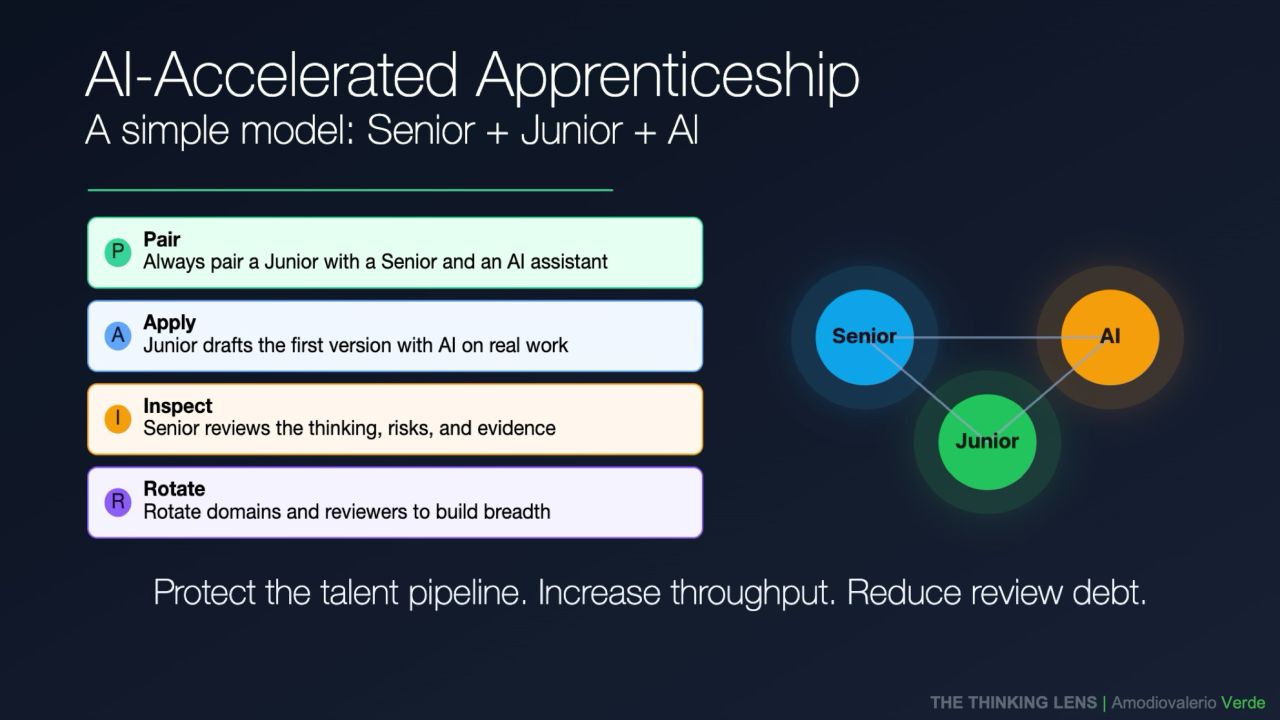
A matrix only becomes a loop when you can measure movement through it. Amodiovalerio Verde supplied that with his PAIR loop, Pair, Apply, Inspect, Rotate, and, more usefully, a way to instrument it: a levels-of-independence rubric running from shadowing up to multiplier, plus two metrics tracked monthly, time to independence and bench strength. The vertical levels of the matrix become a ladder you can attach those numbers to. That is what turns formation from a soft cultural side-effect into measurable throughput, which is the thing a CFO can actually fund. Formation loses every budget fight while it is described as proximity and culture; it wins a different fight when it has a metric.
The funding
The cleanest funding source is one most organisations are already paying for. Dmitry Zharnikov 's point: enterprises are now forced to write evaluation criteria for AI governance, audit and model risk, and that artifact already has a sponsor and a budget line. So write the governance rubric, from day one, so it doubles as a teaching instrument. The same document that governs the agent forms the person.
His version is worth keeping. Legible is not enough; the criteria have to be adjudicable. A mission statement is legible and transmits nothing. A criterion a junior can run a real case against forms judgement. One artifact, two jobs, formation and audit, read from each end.
The economics
Once judgement is what remains after AI takes the task volume, it stops being a soft attribute and becomes a priced, compensable skill. Lewis Lee's observation connects two things usually kept apart: skill-based pay and the second loop need the same input, criteria a junior's calls can be scored against. Which means pricing judgement and forming it are the same project funded twice. The grid that scores a junior for development is the grid that grades them for pay.
The honest concession
Judgement is an input, not the finish line. Patrik Eriksson reframed it: enterprises actually compete on coordinating competing judgements into coherent action, and that coordination is the harder, larger management problem. Formation is upstream of it; you cannot coordinate judges you never made. But the second loop only solves the upstream half, and it would be dishonest to pretend the reconciliation layer above it is solved by the same move. It is not. It is the next problem.
The precedent
There is one industry that already lived this and responded. Arun Kumar Raghunathan brought it: aviation. Autopilot eroded manual flying, and the response was not to celebrate the freed-up attention. In 2013 the FAA issued a safety alert, after flight-data analysis showed rising manual-handling errors, telling operators to give pilots deliberate opportunities to fly by hand, because continuous reliance on automation degrades the skill needed to recover an aircraft from a bad state. They put manual flying back on the schedule on purpose.
Business has no such regulator. Nobody will mandate a second loop into existence. Which means the schedule aviation imposed by rule, every organisation that wants to keep forming seniors will have to impose on itself, voluntarily, against the short-term pull of pure efficiency.
That is the whole exercise. Take the grid you already have, run it once for efficiency and once for formation, and put the training back into the cells where the work stopped doing it for you. The version that finds where your bench is one person deep is the same version that tells you which junior to start forming on Monday.
Sources
Walter Quattrociocchi, Valerio Capraro, Matjaž Perc, "Epistemological Fault Lines Between Human and Artificial Intelligence," arXiv:2512.19466, 22 December 2025. The seven fault lines (grounding, parsing, experience, motivation, causal reasoning, metacognition, value), the human-vs-LLM judgement pipeline figure, and the concept of Epistemia. https://arxiv.org/abs/2512.19466FAA, Safety Alert for Operators (SAFO) 13002, "Manual Flight Operations," 2013. The aviation precedent: operators urged to preserve manual flying skills against automation-driven erosion. https://www.faa.gov/sites/faa.gov/files/other_visit/aviation_industry/airline_operators/airline_safety/SAFO13002.pdfFAA, SAFO 17007, "Manual Flight Operations Proficiency," 2017, the follow-up reinforcing the same point. https://www.faa.gov/sites/faa.gov/files/other_visit/aviation_industry/airline_operators/airline_safety/SAFO17007.pdfAmodiovalerio Verde , "PAIR: A Simple Model for AI-Accelerated Apprenticeship," The Thinking Lens, 5 September 2025. The PAIR loop, the five Levels of Independence (Shadowing to Multiplier), and the Time to Independence and Bench Strength metrics. https://www.the-thinking-lens.com/pair-a-simple-model-for-ai-accelerated-apprenticeship/ With thanks to the commenters whose contributions are credited inline: Amodiovalerio Verde (PAIR loop; levels of independence; time-to-independence and bench-strength metrics), Dmitry Zharnikov (governance rubric as teaching instrument; legible vs adjudicable), Anish Mitra (rubric as learning instrument, build side), Lewis Lee (priced judgement), Patrik Eriksson (coordination layer), Arun Kumar (aviation precedent).