Thinking · AI & Leadership
The hidden politics of AI adoption
First published on LinkedIn. Read it there and join the discussion →
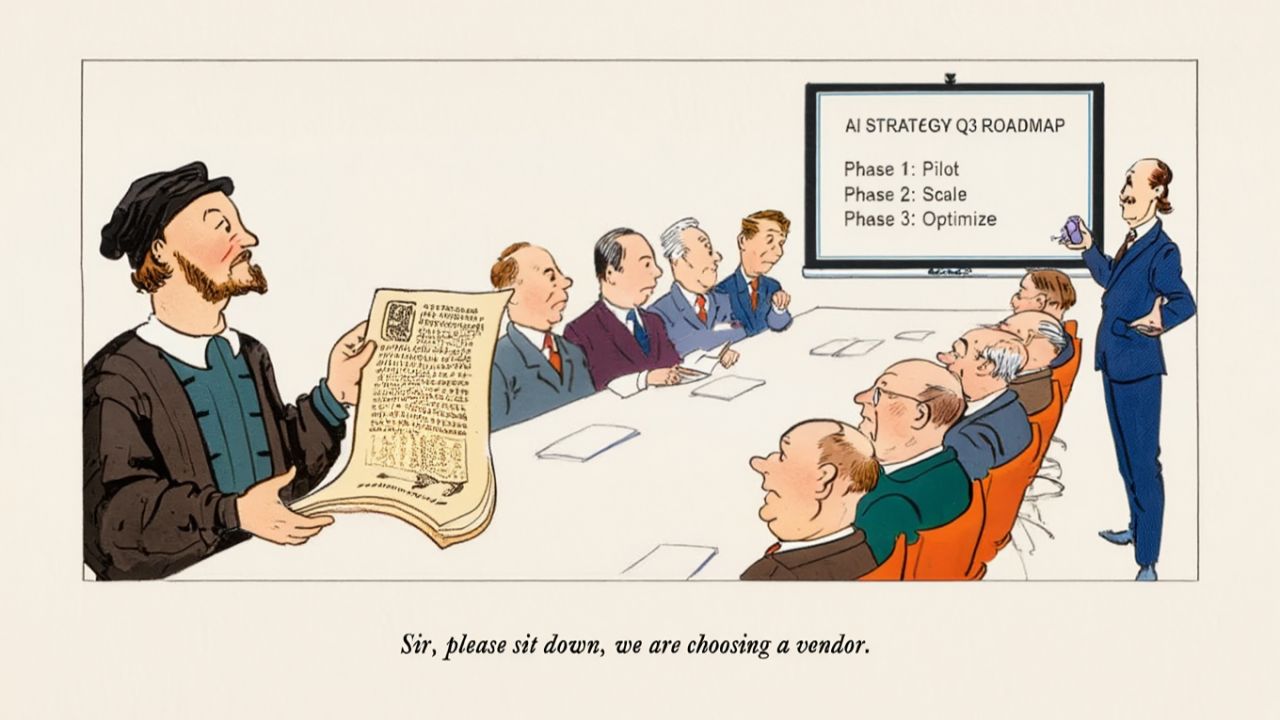
The meeting was supposed to be about choosing an AI platform. Twenty minutes in, it had become something else. The CFO wanted to know who would sign off on what the model produced. The CTO wanted to know whose budget the data pipelines would sit in. The COO, quietly, wanted to know whose headcount will get to revised down. Nobody said any of this out loud. They argued about vendor capabilities for another forty minutes and left the room thinking they had been discussing technology.
That meeting happens, in some version of itself, in every organization adopting AI right now. MIT's NANDA initiative estimates that roughly 95% of the $30 to $40 billion of enterprise generative AI spend so far has produced no measurable P&L impact. That number is being read as a technology problem. However, it is the visible symptom of a political one.
Not a steam engine, a printing press
We keep treating AI like the next steam engine, an industrial revolutionary tool in the making. However, the steam engine was a production shift, it moved physical work from muscle to machine. AI is different it is a cognitive shift, it moves judgment work from human to a model. The right historical parallel is the printing press, not the steam engine. The cultural movement it triggered, from a closed and mostly un-lettered world to an open and. intellectual one, took more than two centuries to fully play out, and we now call its peak the Enlightenment
Elizabeth Eisenstein made this case about printing in "The Printing Press as an Agent of Change." The press did not produce more goods. It produced "a fundamental shift in mentality, which came about due to a basic change in communication and collective memory." And if you are interested in these kind of historic views I can heartily reccomend Joel Mokyr's book "A Culture of Growth" which picks up the same thread, but one historical layer deeper: the Enlightenment was not an engineering revolution. It was a re-ordering of who got to participate in the production of ideas, and that re-ordering preceded and enabled everything industrial that followed.
That distinction matters because cognitive shifts redistribute power differently than production shifts. When work moves from muscle to machine, the political question is mostly about labor. When work moves from critical thinking to a model controlling decisions, the political questions and consequences multiply. Who owns the data the model needs? Who is accountable when the model is wrong? Whose role quietly absorbs the new judgment work, and whose role quietly disappears into a "process" line item on next year's budget?
I have not seen an AI adoption fail because the tool was bad. I have seen plenty fail because nobody answered the political question underneath.
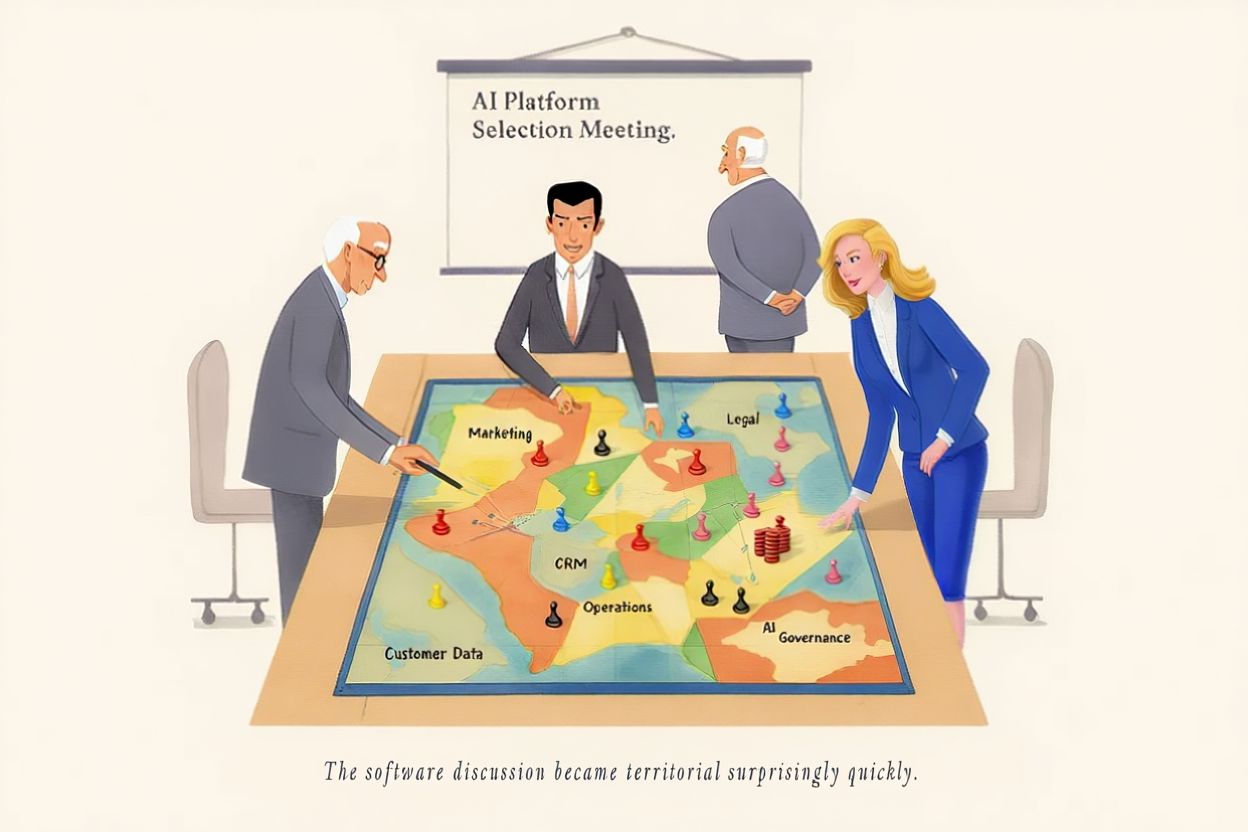
I have seen three distinct patterns keep showing up.
The silo X-ray
You cannot deploy a customer-facing AI agent without resolving the fact that sales, marketing, support, and product own three or four different versions of "the customer." For years, consultants drew that problem on whiteboards and the organization politely ignored it. The agent will not ignore it, but it will simply pick one definition, ship it, and surface the disagreement as a production incident. Gartner's recent enterprise surveys put numbers on the operational version of this story: 41% of organizations cite siloed strategies and 31% cite legacy systems as the primary barriers to AI deployment, and 63% either do not have or are unsure if they have the right data management practices for AI at all. AI did not create those silos. It made them undeniable.
The accountability vacuum
When the model drafts the brief, who signed off on the brief? Who is responsible if the agent sends the email, whose KPI only reflect the opening rate? When the algorithm is unable to win leads, who explains the outcome to a manager that misses its team targets?Most organizations have not answered this. Most are pretending they have. The pretense holds until the first uncomfortable outcome, then it does not.
I have heard more than one business friend quietly admit that when a colleague pushed back on a conclusion in an email they had supposedly written, they had not read the draft before sending it, and could not remember reading it afterward either.
The data ownership war
Data was a hoarding game when nobody could do much with it. AI changes that. Suddenly the team that quietly owns the warehouse, the CRM, or the product performance metrics has leverage they did not have last year. Watch where the internal lobbying intensifies.
And so none of this shows up on the AI vendor's slide. It cannot, because it is not about the vendor. It is about you. The technology choice is the visible surface. The redistribution of power underneath is the real story. Watch where the internal lobbying intensifies. That is your real org chart, not the one in the deck.
The leaders who keep losing on AI are not the ones who picked the wrong tool. They are the ones who treated the power redistribution event as a procurement event.
There is a deeper reason this keeps happening.
The board's one investment thesis
Most boards have exactly one investment thesis for AI, and it is labor replacement. McKinsey's State of AI 2025 finds that efficiency gains are reported as an objective by most organizations, while high performers are distinguished by also pursuing growth and innovation as AI objectives.
If you read between the lines, the pattern is clear: the average board defaults to cost reduction because that is the only AI investment thesis they know how to support and spend political equity on. The Industrial Revolution playbook is the only ROI frame most of them were trained on. Propose AI as power redistribution, and the meeting probably gets politely post-poned.
Propose AI as headcount reduction, and the meeting will move forward every time. The strategic case for focussed AI organization, the one that lives in the redistribution layer, has nowhere to land because the language to evaluate it does not exist around that table yet. In other words, the board has literally not the vocabulary to tackle other options.
That is also why the 95% figure is so stubborn. The projects that do not fit the labor-replacement frame do not get the investment thesis required to scale. They get sponsored as experiments and starved as initiatives.
The Enlightenment did not arrive because someone bought a better printing press. It arrived because the printing press changed who was able to think out loud and share their critical thinking. AI highlights the need for a new step and control of sharp, critical thinking.