Thinking · Brand & AI
The shortlist effect has a dark side nobody's discussing
First published on LinkedIn. Read it there and join the discussion →
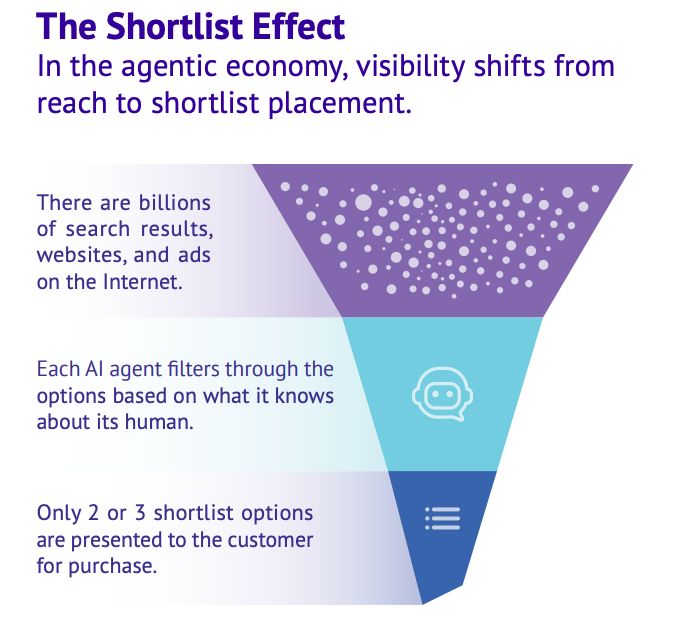
In his manifesto “Brand Constitutions,” agentic branding strategist Thomas Marzano (Former Global Head of Brand & Digital Philips and ASML) introduces what he calls the Shortlist Effect: in an agent-mediated world, visibility shifts from reach to shortlist placement. If your brand doesn’t make an AI agent’s shortlist, you don’t exist. Three brands suggested. One gets the sale. The others? They never even existed.¹
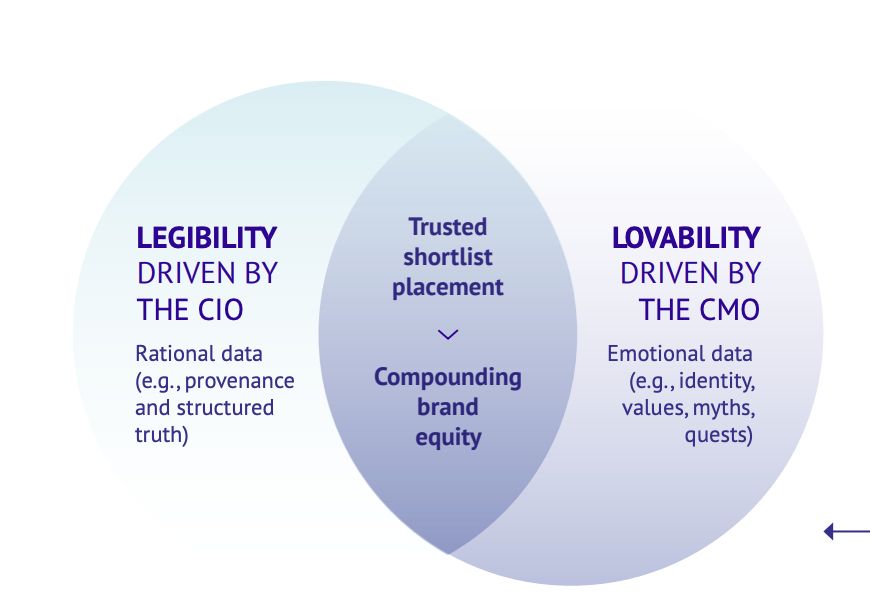
It’s a sharp framing, and one I largely agree with. His ‘Legible-Lovable Law’, the idea that brands must be both machine-readable to be surfaced and emotionally resonant to be chosen, is the best mental model I’ve seen for what branding needs to become. If you haven’t read the manifesto yet, I’d recommend it, read it here, (or dm me, I will send you a PDF copy). It lays real groundwork.
But there’s a problem with shortlists that the current conversation isn’t addressing. Everyone is focused on how to get on the list. Almost nobody is asking what happens once the list solidifies. Or in other words, what happens to new brand exposure once you make clear what your brand preferences are?
The lock-in problem
When your personal AI recommends a brand, it doesn’t forget. It logs the outcome. If you bought the product and were satisfied, that positive signal gets stored. Next time a similar need arises, the agent draws on that history. The brand that worked last time becomes the default. Not because it paid for placement, not because it ran a clever campaign, but because the algorithm has behavioral evidence that it works for you.
This is how recommendation systems have always operated, but agents accelerate the loop dramatically. Traditional recommender systems already exhibit well-documented feedback loops where early preferences compound over time, narrowing the set of options a user ever sees.² Research in algorithmic recommendation systems confirms this: models optimize for accuracy based on past behavior, which systematically reduces exposure to alternatives.³
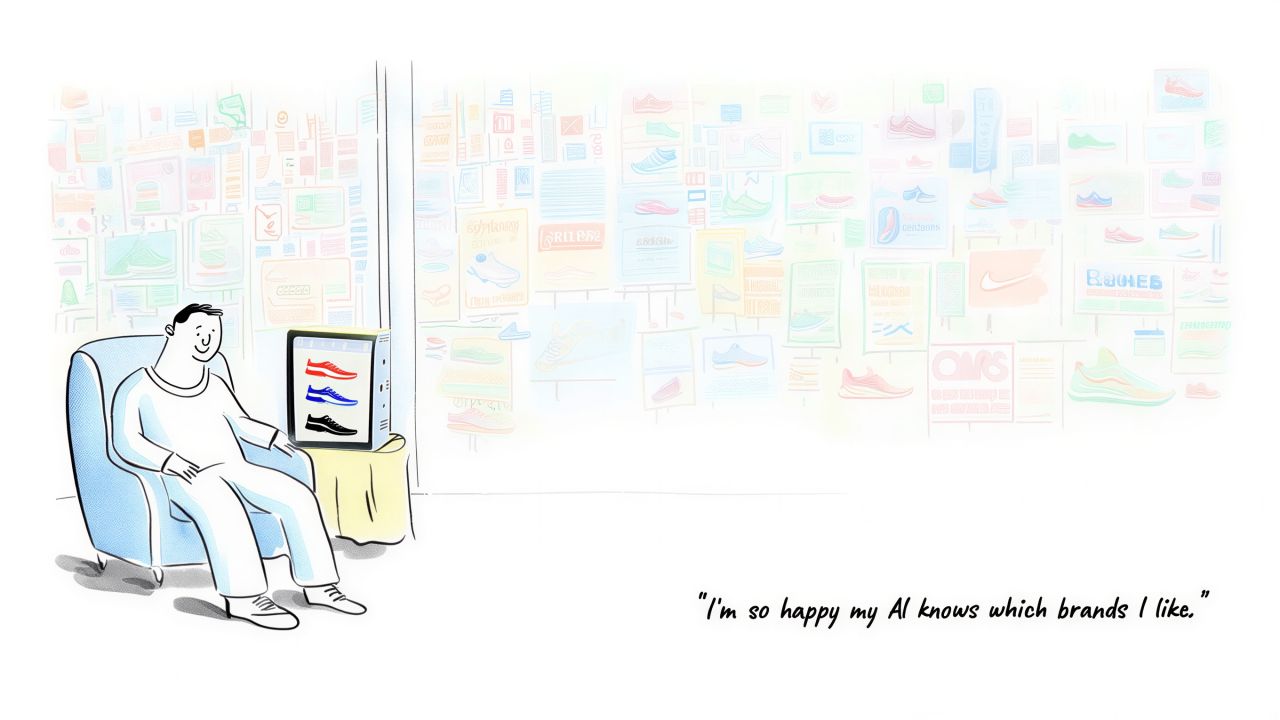
Now add the agentic layer. Your AI isn’t just suggesting products based on browsing history. It’s actively managing your relationship with brands across contexts, conversations, and decisions. It knows that Nike worked for your marathon training. It knows Starbucks resets your afternoon. It knows Volvo matches your driving psychology. These aren’t passive data points; they’re behavioral anchors that compound with every positive interaction.
The result: brand loyalty becomes algorithmically self-reinforcing in a way it has never been before. Not because the brand earned ongoing loyalty through continuous innovation, but because the system has no incentive to test alternatives when the current option delivers.
Think of it as a very extensive and conclusive filter bubble.
Discovery collapse
This is where it gets very uncomfortable for anyone building or growing a brand.
Traditional advertising solved the discovery problem through interruption. You didn’t ask to see that G-STAR or Levis’Store billboard, but now you know they exist. The entire marketing industry was built on the assumption that you could pay to be seen by people who weren’t looking for you.
Agents are designed to eliminate exactly that kind of friction.
Consider the numbers: roughly 60% of Google searches now end without a click to any external website.⁴ When AI Overviews are triggered, that number jumps to 83%.⁴ On mobile, 77% of searches end without clicking through to anything.⁴
Now imagine this in an agent-mediated world. Your personal AI doesn’t show you ads. If you’re running a local model, there is no ad layer at all. Thomas himself points to edge AI as the next major force, with models running locally on devices. The global Edge AI market is projected to grow from $21 billion to $143 billion by 2034.⁵ As that happens, the centralized platforms that could theoretically serve sponsored suggestions lose their role as intermediaries.
So how does a new brand reach you?
The agent-mediated funnel narrows to a handful of routes. Your current brand fails to deliver and so you actively ask your agent to explore alternatives. Someone in your social circle mentions something compelling. Or, and this matters, you’re still a human walking around in the world. A creator you follow, a social ad, a piece of out-of-home that actually lands; these can still generate intent. You’re not sealed inside the ecosystem.
But here’s what changes: the follow-up. Instead of browsing and comparing on your own, you take that spark to your agent. And your agent immediately evaluates it against your existing brand preferences, your history, your behavioral patterns. The lock-in doesn’t block discovery entirely; it raises the bar for conversion after discovery. A new brand doesn’t just need to catch your attention. It needs to survive the comparison your AI runs against every brand it already knows works for you.
That’s a dramatically narrower and more demanding funnel than anything we’ve ever had in the history of marketing.
The training data advantage
There’s a structural layer underneath all of this that makes the problem worse. LLMs are trained on the internet as it existed, and the internet over-represents established brands. For general queries, LLMs default to brands with the highest data density in their training sets; ask a broad question and you get Nike , Apple , Amazon .⁶ This creates a self-reinforcing cycle: major brands appear in more AI responses, which generates more online discussion about them, which feeds future training data, which strengthens their position further. Which is why Share-of-voice is such an important KPI for GEO. Regardless, for highly specific, niche queries the dynamic can shift toward specialized brands with deeper contextual relevance, but the broad discovery layer remains heavily tilted toward incumbents.
Marzano addresses this from the other direction in our online back-and-forths. He notes, correctly, that large brands have the advantage of a massive digital footprint, but also carry the burden of governing it. A decade of inconsistent messaging, contradictory claims, and unresolved customer complaints doesn’t disappear because you wrote a brand constitution. Agents triangulate, and they don’t privilege your version of yourself.¹
Still, when a user asks “what running shoes should I buy for a marathon?” the LLM’s default response will skew toward Nike and Adidas and not PUMA Group . Not because they’re objectively best for every runner, but because the training data says more about them than about any challenger brand. The shortlist is pre-loaded before the user even asks.
The counter-argument matters
It would be intellectually dishonest to present this as a simple “big brands win, everyone else loses” story. There’s a meaningful counter-argument, and it deserves attention.
In traditional search, authority was everything. Backlinks, domain age, and PageRank created a visibility moat that was extremely expensive to breach. But LLMs don’t work that way. They treat authority and relevance as separate factors. SEO dominance does not automatically translate to LLM influence.⁷
This means a challenger brand with highly specific, detailed content, strong reviews, and precise semantic data can outperform a larger competitor that relies on broad authority without depth. The playing field isn’t level, but it’s configured differently than what we’re used to. And that difference creates genuine opportunity for brands that understand how to build for agent legibility from the ground up.
As Marzano puts it: new brands can go “AI native” in their governance, which could create an extreme accelerator. They don’t carry the governance debt of a decade of inconsistent digital presence.
The question nobody is asking
So what is keeping me up these days, next to my often waking son ;)? If agents increasingly mediate brand discovery, selection and experience, and if those agents are optimized entirely for user satisfaction rather than market diversity, then who is responsible for ensuring consumers are exposed to alternatives?
Is the branding world working towards self-fulfilling brand monopolies?
Traditional media had regulation. Broadcast spectrum was limited, so bandwidth and airwave access was governed. Digital advertising had transparency requirements. Even search engines faced antitrust scrutiny over preferential placement.
But personal AI agents sit in an entirely new category. They’re private. They’re personalized. They’re designed to serve one person’s interests exclusively. There’s no mechanism, and arguably no mandate, for them to surface brands that might challenge a user’s existing preferences.
Should ChatGPT, Claude, or Gemini actively diversify their recommendations? Should they occasionally introduce a brand the user hasn’t asked about, simply to prevent the shortlist from solidifying? Or is pure optimization for user satisfaction the right design principle, even if it means new brands face structural invisibility?
These aren’t rhetorical questions. They’re design decisions that will shape trillion-dollar markets. And they’re being made right now, largely without public debate.
What this means
Marzano’s Brand Constitution framework is the best starting point I’ve seen for how brands should prepare for an agentic world. The Legible-Lovable Law is real. The need for structured, machine-readable brand identity is urgent.
But the conversation needs to move beyond encoding quality. The infrastructure that determines which brands get surfaced, how discovery works when the ad model collapses, and who governs the balance between user optimization and market diversity; these are the questions that will define the next decade of brand strategy.
The shortlist effect is powerful. But its dark side, the structural lock-in it creates and the discovery vacuum it leaves behind, is the challenge that no framework has yet solved.
The brands that thrive won’t just be the ones that encode best. They’ll be the ones that understand the architecture they’re encoding into, and fight to keep it open.
Thomas Marzano’s manifesto “Brand Constitutions: The Legible-Lovable Standard for Building Equity in an Agentic Economy” is available on Brandingmag. It’s essential reading for anyone serious about where branding is headed.
Sources:
¹ Marzano, T. “Brand Constitutions: The Legible-Lovable Standard for Building Equity in an Agentic Economy.” Brandingmag, November 2025.
² Ray Jiang et al. “Degenerate Feedback Loops in Recommender Systems.” AIES 2019, ACM.
³ Huang, Z. et al. “The Application of Large Language Models in Recommendation Systems.” arXiv, 2501.02178, 2025.
⁴ SparkToro. “2024 Zero-Click Search Study.” ~60% zero-click rate overall; 83% on AI Overviews; 77% on mobile.
⁵ Polaris Market Research via All About AI. “Edge AI Statistics 2025.” Global Edge AI market: $21.19B (2024) projected to $143.06B by 2034.
⁶ Page One Power. “How LLMs Choose Which Brands to Mention in Results.” Training data density and brand favoritism in LLM outputs.
⁷ To The Web. “How SEO Is Different from LLM Optimization.” Authority vs. relevance in AI search visibility.