Thinking · AI & Brand
Why did I built my own MCP server?
First published on LinkedIn. Read it there and join the discussion →
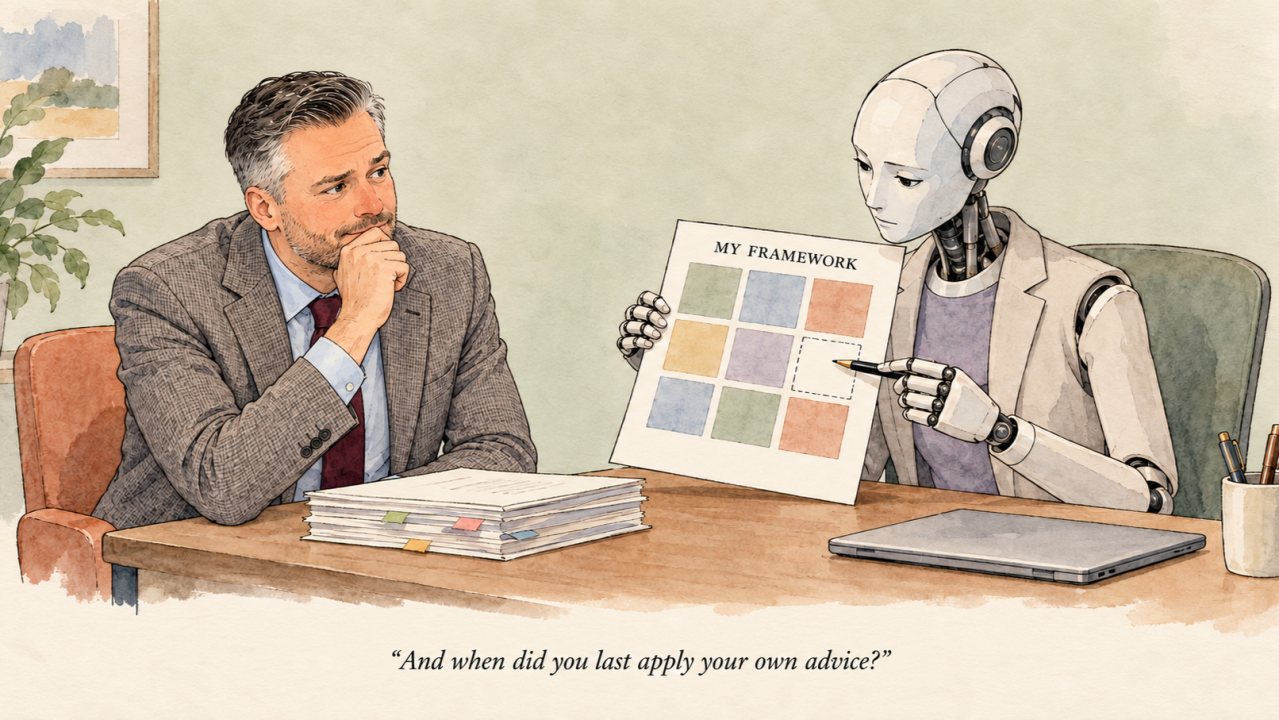
I keep telling clients they need to understand how AI systems read and use their work. So I built an MCP server for my website.
Partly to practise what I preach. Partly because I wanted to understand how the connection actually works in detail: what an AI can retrieve, interact with, what it can use, and where I still need to make decisions. And partly because I am curious by nature. When something changes how we might work, I want to try it and see what happens.
MCP is a protocol, i.e a standard that lets AI applications access external sources and tools. (MCP documentation ) In my case, that meant giving a connected application access to my essays, my enterprise AI map and my skill-matrix gap analysis.
For much of this year, I have been writing about what happens when AI systems describe, compare and recommend brands. A company can publish its positioning, but the version someone encounters in a conversation with an AI is assembled elsewhere. The source material matters. So does what the system selects, leaves out and infers.
The same question applies to someone who advises for a living. If a prospective client asks an AI about my work, what does it actually have to go on? Most of my work before was at companies where I was only a 'cog' in a big machine, so could it even find out what thinkng was.
In my case, the answer was less than I had assumed. My essays were on LinkedIn. My enterprise AI map relied on browser code to display its contents. I had published for people reading pages, without giving much thought to how an AI tool would retrieve the underlying arguments and frameworks.
I put the essays on my own site, with text versions, and made the material available through the MCP connection. Once connected, a compatible application can retrieve the essays and use tools such as the map and skill-matrix gap analysis in the conversation. That gave me something concrete to test with my own work.
Not a magic wand
To be clear, an MCP is not a magic wand. It is just the current flavor that helps the models to make your content / brand more legible. That connection does not mean every AI will now find me or recommend me. It gives a connected application a direct route to the material. The protocol governs context exchange; the application still determines how to use that context. (MCP architecture )
I have used “summonable” to describe the ambition: having your work available when it is relevant to the question someone is asking. Thomas Marzano 's 'Legible-Lovable' framework offers a useful way to think about this: a system needs evidence of both what a brand offers and why it is worth choosing. He rightfully argues that structure and meaning have to travel together. That is a conceptual framework, rather than a tested formula for visibility, and a text endpoint alone does not fulfil it. (Marzano )
A happy coincidence
I expected to learn from building and testing the connection. I had given less thought to what would happen when the AI started comparing the material it could now retrieve. During testing, Claude put my AI enterprise map alongside my essays and identified two gaps in my own thinking.
The first was awkward. In May, I had criticised an agentic marketing framework for leaving out brand safety. My own enterprise AI map, that was build on a few different models I had used over the years, had no such function either. I had published the argument and built the framework without checking one against the other.
The second connected two strands of my work that I had kept separate. My map included a fully autonomous Content Engine and named 'message-drift' as a potential trade-off. My writing on junior development argued that people build judgement through practice: drafting, making choices, getting feedback and trying again, where we focus on a "second-loop" of learning.
Put those arguments together and the cost of the Content Engine changes. Automating the drafting could also remove practice through which someone learns to recognise message drift. The map described the immediate risk to the output. It left out the longer-term risk to the team’s ability to judge it - which leads to a question about 'bench-strength' or succesion strength of the team.
The research backs this up:
Research gives me a reason to take that second risk seriously. In a randomized study of nearly 1,000 high-school pupils, access to a standard GPT-4 interface improved mathematics practice performance, but students scored worse when subsequently tested without it. A tutor designed to guide them with hints avoided that penalty. Better assisted performance did not automatically translate into better independent learning. (Bastani et al., 2025 )
The evidence also shows why the design matters. A study of 5,172 customer-support agents found that AI assistance improved productivity, especially among less experienced workers. Faster handling during later AI outages was consistent with learning, although those estimates were noisy. (Brynjolfsson, Li and Raymond, 2025 )
Neither study tests junior marketers or the concept of an autonomous 'Content Engine'. They sharpen the question I should have asked: where does this workflow give people practice, feedback and responsibility, and where does it remove them?
I readily agreed with both observations and changed the map. It now includes a Claims Guardian, with a boundary: an agent can check claims against agreed rules; people remain responsible for deciding whether those rules are adequate. The Content Engine now includes the potential cost to junior development. The skill matrix also has a status for work AI handles end-to-end without human review: “reps gone”.
AI versus my judgement
Neither observation required the AI to invent a new argument. The material was already there. It brought the arguments together, and I had to decide whether the criticism held. This highlights where a very important strength lies for LLM's, it is indeed very powerful in identifying data gaps, or logic gaps. However, why it is able to work so well is because of the data, in this case the documentation of my thinking, spanning years of experience and judgment development.
Which is why eventhough I could compliment the AI for pointing out those gaps, my judgement still very much matters. Research on sycophancy has shown that AI feedback can bend towards a user’s stated views. A convincing critique needs checking against the original material. (Sharma et al., 2023, revised 2025 )
That is the part I want to keep using. An essay, a framework and a workshop can each make sense on their own while resting on assumptions that do not quite fit together. Sometimes that reflects a genuine change of mind. Sometimes the context differs. And sometimes, as with my missing trust function, I simply missed something.
Building this gave me a more concrete understanding of the technology I discuss with clients. It also gave me a way to test whether I had applied my own advice consistently.
I’ve made the MCP connection publicly available, so you can try it with my published essays and tools. It is also listed in the official MCP Registry, where you can find the connection details. https://registry.modelcontextprotocol.io/?q=nielslangereis
Connect your AI assistant and ask it to compare one of my essays with the enterprise AI map. Where have I failed to apply my own advice? I live to hear your feedback, but also if you have worked on some experiments you did yourself.
Sources and further reading
1. Model Context Protocol documentation (2026). Introduction and architecture , documentation version 28 July 2026. The primary technical explanation of how applications connect to sources and tools. Useful for understanding the boundary between providing context and deciding what to do with it.
2. Thomas Marzano , The Legible-Lovable Law (2026). Canonical statement , updated 14 October 2026. A conceptual framework for carrying brand structure and meaning together through AI-mediated encounters. Read it as a strategic argument, not empirical evidence of a ranking mechanism.
3. Bastani et al., Generative AI without guardrails can harm learning (2025). PNAS paper , 25 June 2025. A classroom-randomized mathematics study that distinguishes assisted task performance from subsequent unaided learning. Its short-term educational setting limits direct generalization to professional development.
4. Brynjolfsson, Li and Raymond, Generative AI at Work (2025). Quarterly Journal of Economics paper , published 4 February 2025. A workplace rollout involving 5,172 support agents provides counterevidence to blanket claims about deskilling. The learning interpretation is suggestive; the rollout was not randomized and the outage estimates have limitations.
5. Sharma et al., Towards Understanding Sycophancy in Language Models (2023, revised 2025). Research paper , first submitted 20 October 2023, revised 10 May 2025. Examines how assistant feedback can follow user beliefs and preferences. A useful caution when asking AI to critique your own work; it is not an evaluation of this particular MCP setup.
6. Shen and Tamkin, How AI Impacts Skill Formation (2026). Preprint , 28 January 2026. A small randomized experiment with 52 participants learning an unfamiliar Python library found lower subsequent unaided quiz performance with AI assistance. Interaction patterns involving explanations are worth exploring, but were not themselves randomized.
7. Lewis et al., Retrieval-Augmented Generation for Knowledge-Intensive NLP Tasks (2020). NeurIPS paper , first submitted 22 May 2020. Foundational reading on combining generation with retrieved documents. It supports the value of external source access in the tested tasks; RAG and MCP are different concepts, and the paper does not establish reliable strategic critique.