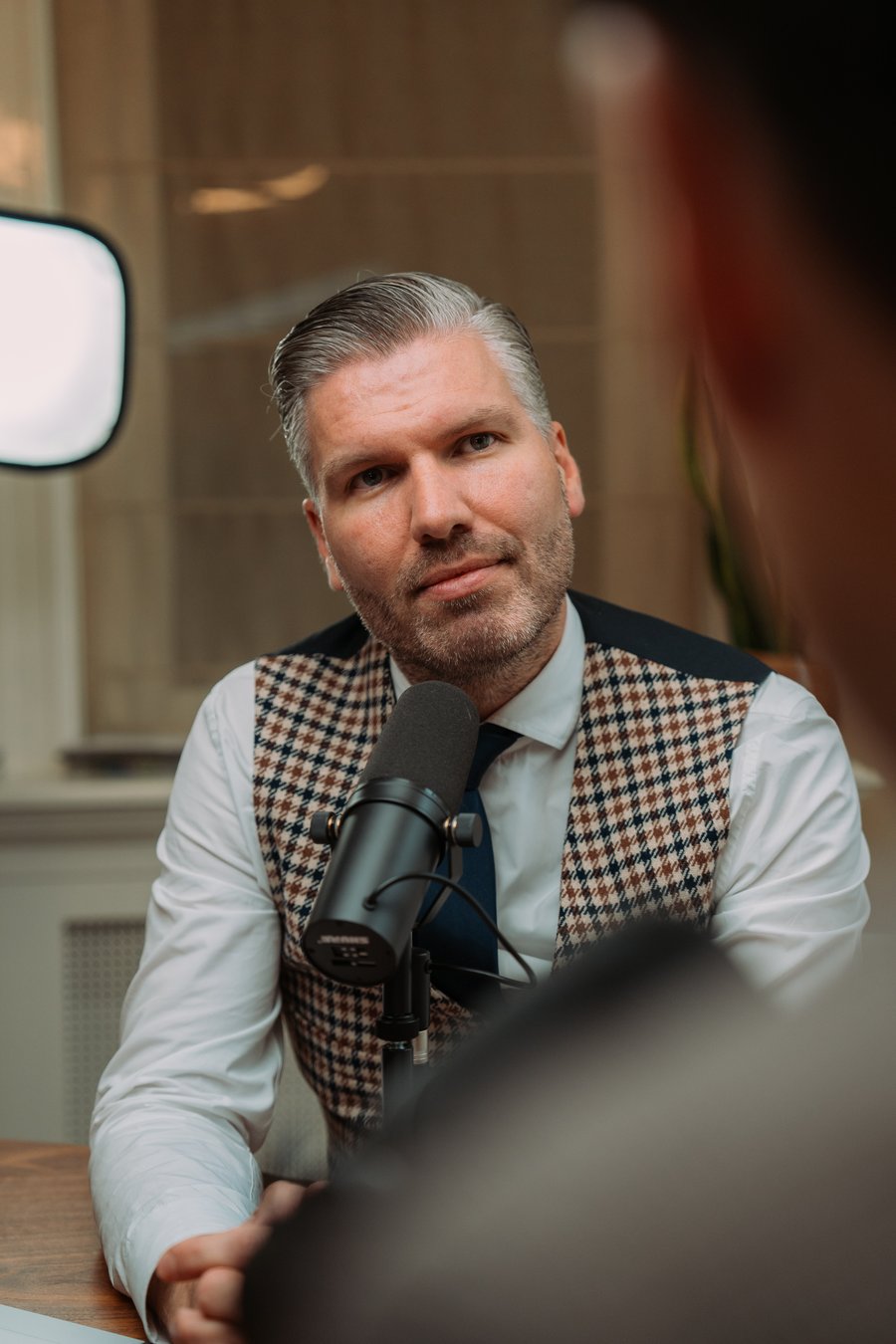
I set the strategy,
and I can read the stack it runs on.

Strategic operator. Positioning, proposition and go-to-market for scale-ups and mid-market companies, set by someone who has carried the P&L, sat in the CEO seat, and still builds.

Let's talk Based in the Netherlands. Working with ambitious companies across Europe.
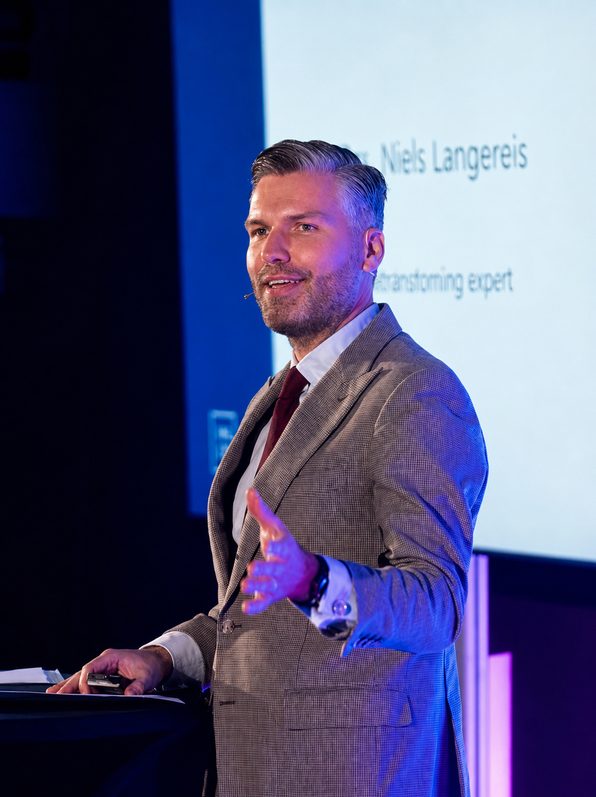
Niels Langereis speaking

The gap

Between ambition and execution

Most scale-ups hit a ceiling. You have a solid marketing manager or head of marketing, maybe even a small team that's doing good work. But there's no one connecting marketing to the boardroom. No one translating commercial strategy into a plan that actually moves revenue.

Usually it is not a thinking problem. Most companies I meet have a reasonable strategy somewhere in a deck. What is missing is someone senior enough to make the calls it implies, and close enough to the work to notice when the plan and the reality have quietly stopped matching.

Sometimes the challenge runs deeper. The company is between CEOs, leaning on a CFO to keep things running, or the founder needs a sparring partner who has sat in that seat before.

That's where I come in.

What I'm building

The proof is a product, not a deck

Most people at my level stopped building a long time ago. I did not. Since the start of 2026 I have been building Chainge, a research preview that maps how global events connect to local business exposure. The thesis is short to state and harder to prove: any global event connects to your local exposure in six steps or fewer. Chainge finds those steps.

The methodology rests on work older than most AI platforms. Mark Granovetter's 1973 paper on weak ties argued that the most valuable information travels through weak connections between different clusters, not through strong ones within them. Watts and Strogatz formalized that as small-world topology in 1998. Surowiecki and Page-Hong showed that diverse groups outperform homogeneous experts at prediction problems. Chainge operationalizes all three at scale.

It runs as a governed multi-agent system: a conductor, specialised seats for research, marketing and sales, graded autonomy modes, and a written charter with one rule at the centre of it. Anything that reaches a real person stays mine. Delivery is the gate. Every prediction carries a probability and a 90-day verdict horizon, and the verdict gets published. Right, partial, wrong, or unclear. No retroactive editing.

I am not telling you this because I want to sell you a product. I am telling you because it is the only honest way to prove the thing I actually claim: that I can hold a strategy and read the stack it runs on at the same time. Writing a requirements document instead of a briefing, spotting that one sentence in a proposition moves the whole thing into a different regulatory category, knowing where a system will break before someone builds it. That is not a separate service. It is what a client is buying when they hire me instead of an advisor. The site lives at chainge.global.
How I can help

Two ways I work with companies

You will not find a separate AI offering here, and that is deliberate. AI is not a workstream you buy next to your positioning and your operating model; it is the condition both now operate under. It runs through everything below rather than sitting beside it.

Positioning, proposition and go-to-market, owned end to end

I step into your leadership team, typically 2 to 3 days per week, in whatever seat the work needs: from CMO to the lead on a specific programme. Not as a consultant who hands over a strategy document and leaves, but as a member of your team who owns the outcome and is there when it has to survive contact with the market.

  • Defining positioning, proposition and pricing, and gating every claim on what you can actually defend
  • Connecting marketing to commercial goals, pipeline and the numbers the board reads
  • Redesigning the marketing operating model around AI workflows and agents: who does the work, who checks it, and who owns it
  • Getting a marketing team to work AI-native, with governance, workflows and capability that stay in place after I leave
  • Making sure your brand is found and chosen when an AI assistant builds the shortlist
  • Coaching your existing team, and keeping juniors on the work that still forms judgement
  • Bringing structure to what's working and killing what isn't
Best fit: PE and VC-backed scale-ups and mid-market companies with a marketing team in place but no one connecting it to the boardroom.

A second operator in the room

Not every company needs a full-time CEO to move forward. Sometimes what is needed is someone who has carried the P&L, made the reorganisation calls, and sat in the seat before, who can step in part-time to give direction, challenge the leadership team, and keep momentum.

  • Interim CEO for companies in transition
  • Sparring partner to founders, or to the CFO currently carrying the CEO load
  • Leading a leadership team through a growth phase, an acquisition or a restructure
  • Telling a board what a technology bet is actually going to cost, before it becomes a leadership problem
Best fit: Scale-ups between CEOs, founder-led companies ready for a different kind of leadership, or boards that want an experienced hand during a transition.

How I work

Built for momentum, not dependency

I typically engage for an initial period of 3 to 6 months, with the option to extend. The goal is always to build capability, not create a permanent seat for myself. I work embedded in your team, join your meetings, and operate as if the company were my own.

Immersion first

Every engagement starts with 2 to 3 weeks of going deep: understanding your market, your team, your numbers, and where the real leverage is.

Embedded, not external

I join your leadership meetings, work alongside your people, and take ownership of outcomes. This isn't advisory from a distance.

Focused attention

I work with a small number of companies at a time. If we work together, you get my full attention.

About

A bit about me

Niels Langereis

I've spent 20+ years in marketing, digital strategy, and commercial leadership, moving between agency life, corporate environments, and building things from scratch. The through line is that I have always stayed close to how the thing actually works. I read the contract, I read the spec, and I would rather find out where something breaks myself than be told about it in a steering committee.

Until early 2026, I led the central marketing organization at Normec, a PE-backed group, connecting marketing across 80+ companies in 12+ countries. There I also wrote the group-wide AI handbook and governance framework, and built the central innovation and AI team. Before that I was CEO of New Story and spent six years in WPP leadership, including running Hogarth in the Netherlands on a €10M P&L with 125 people. I also serve on the board of iTRACE. Along the way I worked with companies like Netflix, Vodafone, IKEA, Philips and Albert Heijn.

Alongside the advisory work, I'm building Chainge (described above). The day-to-day is different from advising. Different stakes, different feedback loop, different kind of clarity required when you're the one shipping.

I started young. While still in college I launched a social media consultancy that, within six weeks, had me on a call with Myspace Europe about their Dutch launch. That early sense of "just figure it out and build something" never left. Twenty years and several boardrooms later it is still the thing I am most useful for.

My philosophy

I don't think leadership is about having all the answers. It's about creating the conditions where smart people can do their best work, where decisions are made from understanding rather than noise, and where every challenge is treated as a chance to learn something.

As a manager, I'm a coach first. I care about helping people discover their strengths and turn those into something meaningful. Growth that only serves the company but ignores the people building it isn't growth worth having.

Speaking

Talks, podcasts and lectures

I speak about what AI is doing to how organisations work, how brands get chosen and how people build a career. Always from the side of the organisation that has to make it work, rather than the vendor selling it. Practical, with a bit of history and a bit of humour, and built to leave a room ready to act.

Niels Langereis in conversation

Topics

  • If AI takes the junior work, where does the next senior come from? What happens to talent, judgement and the agency model when AI takes over the executional, analytical and production layer.
  • The hidden politics of AI adoption. Why adoption stalls on who signs off, whose headcount shrinks and whose budget it comes out of, not on the technology.
  • Found and chosen by an AI assistant. What happens to brands when an AI builds the shortlist, and to the ones that are not on it.
  • Who owns a good idea? Intellectual property, creativity and responsibility in the age of generative AI.

Recent and upcoming

  • Emerce, video talk on AI taking over executional work and what it means for organisations, talent and agencies, October 2026
  • Lecture Lounge, "Who owns a good idea?", Generator Amsterdam, September 2026, sold out
  • Adformatie and SWOCC podcast, on AI and how juniors still become seniors, September 2026
  • NHL Stenden, MCMS industry seminar, September 2026
  • Earlier: events for BVA, MWG and IAB, and guest lectures at HKU, UvA, HvA and NHL Stenden

Organising something? A short bio and photo are here, and the quickest route is a call or an email.

Giving back

Some of the most rewarding work I do isn't for companies. It's for people who are just getting started.

I've spent years lecturing at universities like HKU, UVA, HVA, and NHL Stenden, and I keep coming back because nothing beats watching someone make a connection that changes how they think about their career. Marketing, AI, leadership, building something from nothing; these are things I've learned the hard way and I'd rather share them than keep them to myself.

If you're a young professional or student figuring out your path in marketing, digital strategy, or AI, I'd genuinely like to help. Whether that's advice over a coffee, an introduction to someone in my network, a guest lecture for your program, or just an honest conversation about what this industry actually looks like from the inside.

For young professionals and students

I'm always open to connecting with people who are curious and driven. A few ways I can help:

  • Career advice and honest feedback on your plans
  • Introductions to people in my network who might be relevant for you
  • Guest lectures and workshops on AI, marketing, and leadership
  • Mentoring conversations; no agenda, just a willingness to listen and share

Don't overthink it. Just reach out.

Thinking

What I'm working through

I write most weeks, mostly about trust and attention: how they are won, moved and destroyed, whether the player is a brand, an algorithm or an institution. The questions that get called new tend to be old ones wearing better clothes.

AI & Leadership

We keep firing the honest fool

A model that tells you what you want to hear is not a bug in the technology, it is a preference we trained into it, and one organisations have been training into people for a lot longer. Amsterdam, 1637: the man who called the tulip market right got run out of the room.

Read on LinkedIn →

Brand & Private equity

At a buy-and-build, a strong brand is often a missed opportunity

There is a confident genre of content right now: the fractional CMO who unlocks EBITDA for private equity. Almost every piece frames brand the same way, and almost every piece misses where the value in a buy-and-build actually sits.

Read on LinkedIn →

AI & Talent

The coordination problem no agentic roadmap has priced

Part three. Every company can rationally decide not to train the juniors it no longer needs, and the industry still ends up short of seniors in a decade. Nobody's roadmap has a line for the cost of that.

Read on LinkedIn →

AI & Talent

Juniors don't build judgement by overseeing AI

The practical sequel: watching a model work no longer forms anyone. Run a gap analysis over the competency grid you already have, then build a deliberate second loop that routes real calls back to juniors so judgement still gets made. Aviation learned this the hard way and put manual flying back on the schedule.

Read on LinkedIn →

AI & Talent

If AI takes the junior work, where does the next senior come from?

AI is eating the execution layer from the bottom, the rung where people used to start. Keep juniors on the payroll and you can still produce a generation that never earns judgement. A system can inherit judgement; it cannot make more of it.

Read on LinkedIn →

AI & Leadership

The CEO AI panic of 2026 is a governance failure, not a leadership one

Most CEOs now fear their job rests on AI paying off, and boards are filing the shortfall under leadership. The real issue sits one seat over: boards underwrote a cost-cutting bet, then grade the CEO on a growth one. That is a governance failure, not a leadership one.

Read on LinkedIn →

Marketing

Marketing is where the operating model breaks

A response to HBR's agentic-marketing piece. Marketing is not the bottleneck because marketers are slow; it is where a broken operating model first becomes visible. The orchestration layer everyone calls efficiency is really a question of who owns the work, who carries the risk, and whose budget it sits in.

Read on LinkedIn →

AI & Leadership

The hidden politics of AI adoption

The meeting was supposed to be about choosing an AI platform. Twenty minutes in it had become something else: who signs off, whose headcount shrinks, whose budget it comes out of. Most adoption does not stall on technology.

Read on LinkedIn →

Contact

Let's figure out if there's a fit

Drop me a line. I'll get back to you within 24 hours and we can set up a call to see if working together makes sense. No pitch decks, no proposals before we've talked.

For talks, podcasts and media the same address works, or call me directly.

Niels Langereis Advisory

Baarn, Utrecht, Netherlands

+31 6 3191 4529

mail@nielslangereis.com

Subscribe to my newsletter